


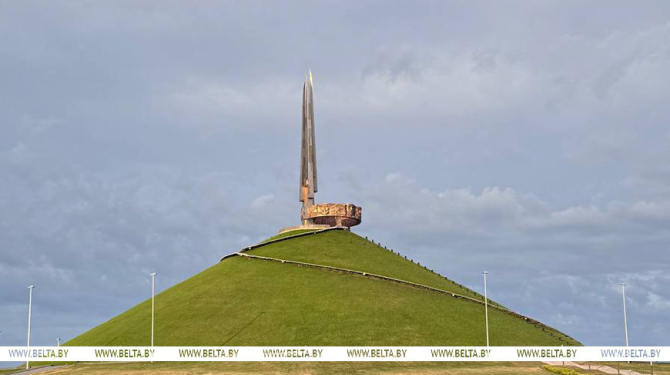
This year marks the 60th anniversary of the groundbreaking ceremony of the memorial complex “Mound of glory of the Soviet Army – the liberator of Belarus”, built to honor the feat of the soldiers who took part in Operation Bagration, the codename for the operation to liberate Belarus from the Nazi invaders. This man-made mound, containing soil from hero cities, has become a tangible embodiment of victory, independence and the unbreakable bond between generations. Everyone who climbs to its summit remembers the tremendous price paid for peaceful skies over our country. Six decades later, this sacred place for every Belarusian remains a symbol of national pride, bringing together the past, present and future of the Belarusian people.
A nationwide cause. Construction of the “Mound of glory of the Soviet Army – the liberator of Belarus” memorial complex
The majestic man-made Mound of Glory was built at the 21st km of the Minsk-Moscow highway. It was here that a 150,000-strong grouping of Hitler’s troops was encircled during Operation Bagration in July 1944 – an event that became known as the Minsk Pocket.
The decision to build the Mound of Glory memorial was made on 18 August 1966. When designing the memorial complex, its creators – the sculptors Andrei Bembel and Anatoly Artimovich, the architects Oleg Stakhovich and Lev Mitskevich, and the engineer Valery Laptsevich – sought austere and strict simplicity. The majestic Mound of Glory blends harmoniously into the surrounding landscape, is clearly visible from afar and from all four roads at which intersection it stands.

Construction of the Mound of Glory at the 21st kilometer of the Moscow highway, 1967
The construction of the Mound of Glory became a people’s cause. Thousands of people considered it their duty to contribute to this effort. People from all corners of the Soviet Union tried to bring some soil in memory of those who gave their lives for peaceful skies. Soil was brought here from Belarusian cities and villages, the hero cities of Moscow, Leningrad, Volgograd, Sevastopol, Odessa and Kiev, the legendary Brest Fortress and other memorable places associated with the heroic deeds of Soviet people during the Great Patriotic War of 1941-1945.
Film and photographic newsreel footage shot at the time conveys the unprecedented zeal and enthusiasm, with which people came to the construction site of the Mound of Glory to lay, handful by handful, the soil they had brought with them. Huge lines of people wishing to take part in creating this majestic, truly man-made monument formed. Only after the pilgrimage of those wishing to add a handful of soil had ended did excavators and trucks start working here.

Opening of the Mound of Glory on the 25th anniversary of the liberation of Belarus from the Nazi invaders
The memorial is 70.6m high in total. A 35m-high earthen mound is crowned by a sculptural composition of four bayonets, each 35.6m high. The bayonets symbolize the fronts that took part in the liberation of Belarus: the 1st, 2nd and 3rd Belarusian Fronts and the 1st Baltic Front.
A broad stone ring surrounds the foundation of the obelisks. Inside it is a mosaic inscription “Glory to the Soviet Army, the Liberator Army!” and mosaic images of the Orders of the Patriotic War and of Glory. The outer surface of the ring features bas-reliefs of faces symbolizing generalized images of defenders of the Motherland (a young female partisan, an old partisan, a pilot, a sailor, a tanker, and young and old infantrymen) covered with gold enamel.
Two staircases, each with 241 steps, encircle the Mound and lead to an observation platform at its summit. Each step is secured separately.
At the foot stands a granite memorial plaque bearing the inscription in Belarusian: “At the Mound of Glory, handful by handful, soil was laid from hero cities and other sites of fierce battles, from cities and villages that forever glorified themselves through military and labor feats for the freedom and independence of the Soviet Motherland.”
To ensure the stability of the structure during construction, a pile foundation extending 30m into the ground was laid. These measures were taken to prevent landslides.
Reconstructions of the Mound of Glory memorial complex
The Mound of Glory has undergone reconstruction several times since its opening.
In May 2003, the republican committee in charge of organizing preparations to celebrate the 60th anniversary of Belarus’ liberation from the Nazi invaders decided to carry out a large-scale reconstruction of the Mound of Glory.
During the first stage of the reconstruction the surrounding area was improved, administrative buildings and utility networks were repaired, and a new irrigation system was installed. During the second stage the upper decorative ring was restored, the steps were repaired and a military hardware museum was established.
In spring 2004, a park named after the 60th anniversary of the Victory in the Great Patriotic War was laid out on the complex grounds.


